
Transportation greenhouse gas (GHG) emissions account for 28% of U.S. emissions—more than any other sector of the economy. Seen as a solution to global and urban policy dilemmas like climate change, air pollution, and traffic congestion, the electric vehicle (EV) market is growing, now representing 10% of the market in the United States.
Soren Anderson, Ph.D., associate professor in the MSU Department of Economics, studies the economics of energy and the environment, focusing on markets for cars and the fuels they use, including oil, gasoline, biofuels, and electricity.
Subsidizing Cars and Charging Stations
In his energy economics class, Anderson teaches that the government should generally let markets do their thing—unless there’s a market failure of some kind. In the case of EVs, he cites a couple reasons why the government might want to get involved. For example, when firms such as Tesla or Chevy build new cars and introduce new technologies, they do that through intentional research and development, and they learn how to do it better. New knowledge is gained along the way that they can capture internally to their business through patents and other means, but some of that knowledge spills over to the broader market.
“That means the social benefit of the knowledge that is gained is actually bigger than the benefit to just the individual investing company,” he said. “And so that spillover, or that externality, can create a government justification for subsidies, either directly subsidizing the production of cars or through subsidizing research and development.”
Anderson’s recent work explores the role of the federal electric vehicle tax credit in boosting EV sales. Anderson and coauthors looked at the passing of the Inflation Reduction Act, which renewed eligibility of several carmakers for EV subsidies.
“We saw an increase in US market shares for electric vehicles relative to Canada, our control country. There is a relationship between the subsidies you might provide an industry and the growth or shrinkage of that industry.”
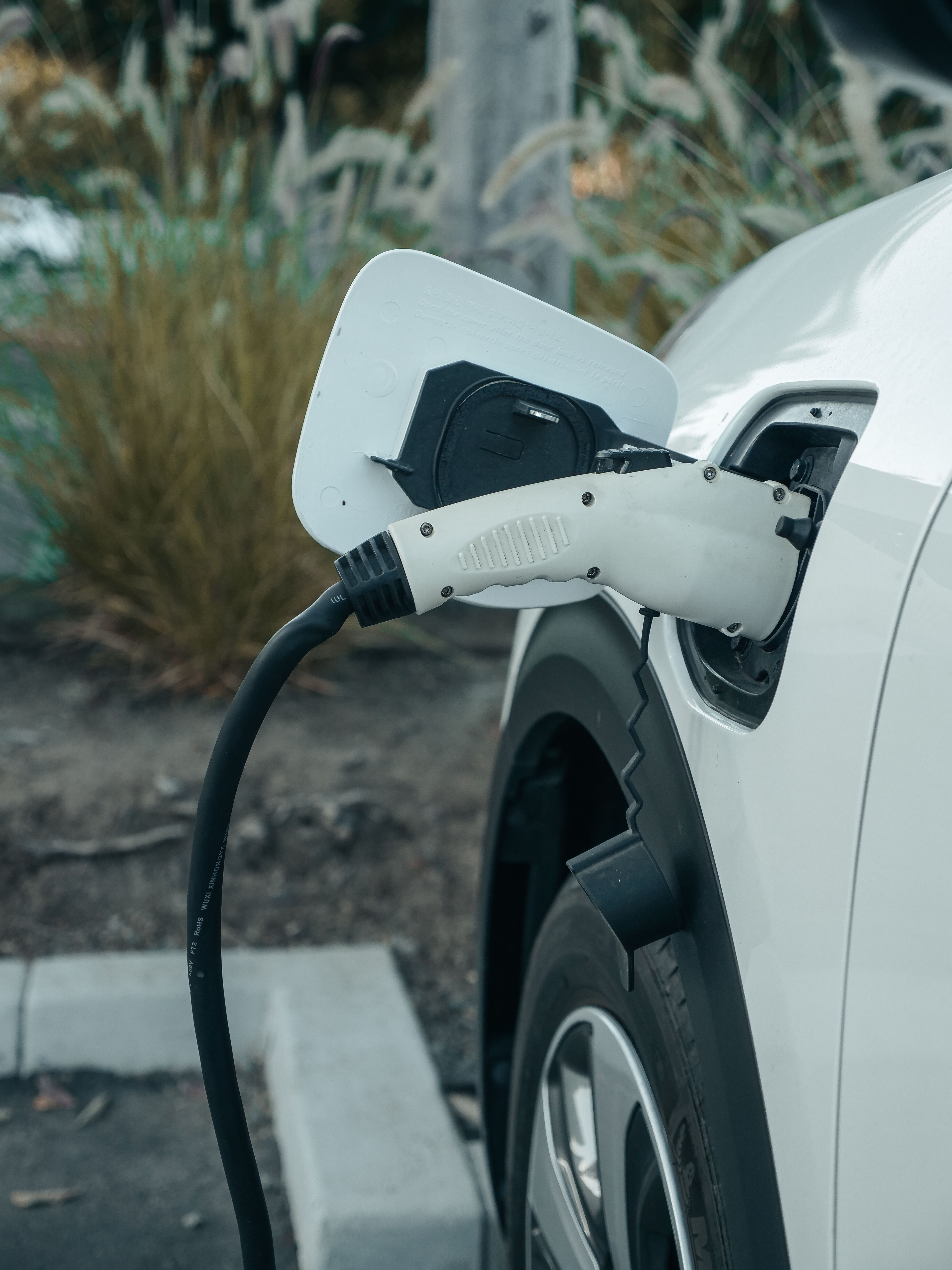
The other important side of the EV market is the public charging stations, allowing people to take longer trips from home. In the last 10 years, there’s been a growth in the number of EV charging stations. According to Professor Anderson, the EV market has a “chicken and egg” problem: cars need stations, but stations need cars. This means early EV buyers will not have access to a robust charging station network, but they will indirectly help future buyers by encouraging more stations to be built with their initial purchase. On the other side, an early investor in a charging station might be unprofitable in their initial investment, but they could potentially help future station owners and future investors by encouraging more EV sales.
“Because of these indirect network externalities operating through the two-sided market, that is another justification for the government to potentially get involved in subsidizing either electric vehicles or stations, to kind of nudge the market along and overcome these external spillovers that are limiting the growth of the market,” he said. “There's actually been some efforts to measure the impact of that based on data and research in Norway.”
Professor Anderson notes that it’s possible to grow the EV market either by subsidizing cars or subsidizing stations or doing both. According to previous research findings in Norway, subsidizing stations is the most effective way to grow the charging network. Cars indirectly impact station network growth, but the most direct way is subsidizing the charging networks.
In fact, until recently, Michigan had a program called “Charge Up Michigan,” where the state, station owners, and utility companies would cost share a charging station.
“Crucially, this cost share was only available at state-approved locations,” Professor Anderson said. “Once a couple chargers had been installed in an area, then the subsidy would no longer be available at that location. They used this approach to try to coordinate the geographic spread of stations across the state.”
The Michigan locations were determined by a consultation with Mehrnaz Ghamami Ph.D., professor with MSU Engineering, who developed a model to figure out the best locations for EV chargers to make most places in the state accessible at a low overall cost to provide electricity.
“I'll be working with her and my econ colleague, Justin Kirkpatrick, to analyze the effectiveness of that program.”
Are EVs better for the environment? It depends.
A key part of the EV discussion is how we’re going to charge using our current electrical grid.
“Are EVs green? Are EVs actually better for the environment? Well, it really depends where and when you are charging your car,” Professor Anderson said. “Both the financial and environmental cost of charging are going to be determined by the marginal generators.”
A marginal generator is the last generator to be turned on to meet additional demand and is generally the most expensive generator running.
“We have the price of electricity fluctuating during the day, so if you charge your electric vehicle during an off-peak, low-demand period, the cost of charging could be low,” he said. “But if you charge your electric vehicle during a peak period, the cost of charging to the grid could be really high.”
Furthermore, while the marginal generators in principle could be wind or solar, more often than not they will be coal or natural gas. It can also be dependent on location and the electrical grid available.
“In the western part of the United States, charging an electric vehicle is going to be better for the environment than using a gasoline car, if you add in all of the environmental impacts,” he said. “But if you look in the Midwest, charging an electric car during off-peak periods might actually be worse for the environment than using a conventional gasoline car, because you are largely using coal to charge your electric car indirectly through your electricity use.”
That’s all from the perspective of an individual EV driver, deciding when and where to charge given the current electrical grid. Looking forward, and thinking from the societal level, if many people switch from gasoline to electric cars, the demand for electricity will increase. The question is whether the new generators built to meet that demand are wind and solar or coal and natural gas. Professor Anderson says that question is important for thinking about grid expansions and EV policy over the long term. If lots of wind and solar are built to meet demand, then the switch to EVs is good for the environment.
Policy to Address the Complexity of the Electrical Grid
“We really would benefit from robust policy that guides our choices with the complexity of our electrical grid system,” he said.
Professor Anderson suggests carbon pricing, such as a tax on fossil energy or a cap-and-trade system, combined with real-time pricing of electricity. The carbon pricing he suggests would ensure that the perceived cost of making electricity and therefore the wholesale prices we observe in the market reflect not just the financial costs of running the generators, but also the environmental impacts that are created by those generators.
“This would immediately make the grid greener by making coal generators less profitable than natural gas generators in the dispatch order, in the ordering of which generators turn on and off as electricity demand ramps up and down,” he said. “And in addition, because wind solar would not face those prices, it would encourage investments in wind and solar, as well as batteries.”
Meanwhile, real-time pricing would give consumers better incentives to charge their EVs during off-peak times, when the overall cost to the grid is low.
Professor Anderson’s Background
Professor Anderson is appointed as a Research Associate at the National Bureau of Economic Research. He previously served on the board of directors for the Association of Environmental and Resource Economists, as a visiting researcher at the Energy Institute at Haas at UC Berkeley, as a staff economist with the White House Council of Economic Advisers, and as a research assistant at Resources for the Future.
He joined MSU in 2008 and holds joint appointments in the Department of Economics and the Department of Agricultural, Food, and Resource Economics. He holds a Ph.D. in economics from the University of Michigan and a B.A. in economics from Macalester College. He has studied a range of issues in energy and environmental economics.
To read more about his research, visit https://sorentanderson.com/.