By Katie Frey; Photos by Jacqueline Hawthorne, College of Social Science
Lego pieces clink as Sierra Smith, economics graduate student, sorts them by color into different bins getting ready to build them into patterned squares. She is replicating the process that participants follow when they come into Spartan Psychology and Economics Advanced Research (SPEAR) Lab to build blocks with LEGO bricks as part of Dr. Ben Bushong’s latest research on people’s behavior. He is an assistant professor in the MSU Department of Economics in the College of Social Science.
Dr. Bushong is attempting to understand how people behave when they receive advice from experts. In broad terms: are people more likely to incorporate expert advice into their behavior long term if they are mandated or if they are given a choice – and why?
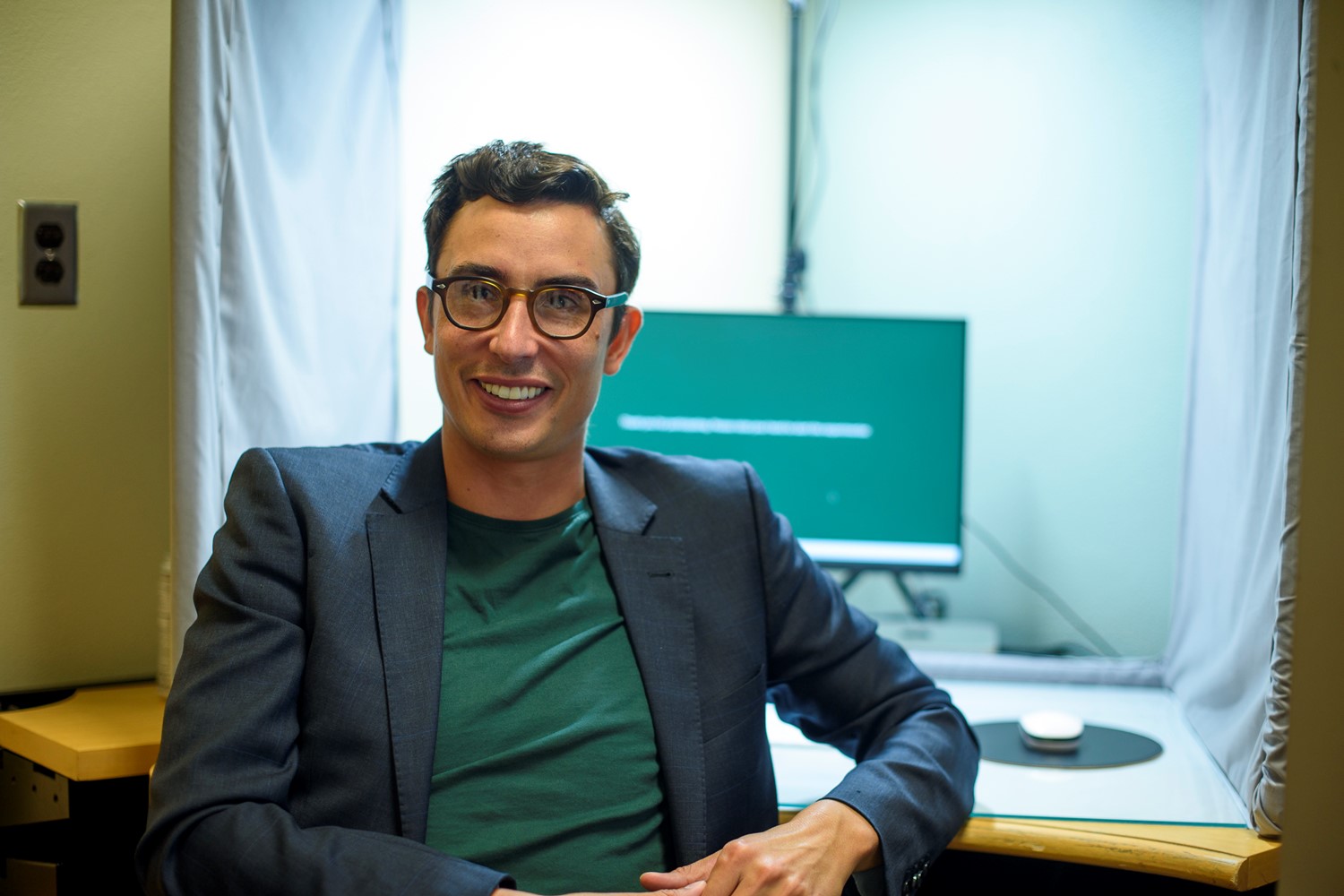
“We are trying to understand what helps people work in a more productive manner and whether people follow expert advice over both the short- and long-term. To make things clear, we simplify the environment as much as possible by tasking participants to build 10 by 10 figures,” he said.
When thinking of economics research, building with LEGO bricks isn’t what typically comes to mind. But to study human behavior, Dr. Bushong has to take large behavioral concepts and make them small, simple and measurable – like LEGO bricks. The experiment seeks to answer: who will produce more built Lego blocks? And who will continue the advised way of building the blocks longer: the participants mandated by the computer to follow the directions – the symbolic “expert advice” -- or the volunteers who were given a choice about following those directions or not.
“If we see a difference, we are hoping to uncover the underlying mechanism. Is it that you remember better, you're more engaged since you chose yourself---that is, you try harder---or is it that you're just happier when you make the choice yourself. By using the lab experiment we hope to tease apart various potential psychological mechanisms that may lead to significant differences in the real world,” he said.
Although the research is designed to be simple, it has complex, real-world implications.
“Why is this interesting? Because if you're a large intergovernmental organization-- like the World Bank, who is a sponsor of this research -- oftentimes, they give aid to countries or municipalities conditional on following specific advice. For example, you have to build a school with these parameters. And we're suggesting that maybe it’s possible that you would get better long-term outcomes, better adherence to whatever policy that you wanted if instead you said: this is what we think you should do but it's up to you. We think that people might still build the same school and do it the same way; but that there'd be a difference in long-term satisfaction,” Dr. Bushong explained.
In addition to the SPEAR Lab being used for faculty research, the lab is also a new element that the MSU Economics Ph.D. students can engage with. Being part of the SPEAR Lab research has been important in Sierra Smith’s Ph.D. program, and she will use some findings toward her own research interests.

“I joined the MSU Economics Ph.D. program because I was interested in experimental economics. But of course, we didn't have a lab until now. So, it's exciting to see it actually happening and to be a part of building it. That's just really exciting for me,” she said. “I’m still in the designing process for my research, but I hope to open it up within the next couple of months.”
Smith will be using the LEGO bricks to do her own research to study what effect completion uncertainty and competition has on people’s efforts. She gave an example of competing pharmaceutical companies trying to make a new vaccine. In this scenario, there is competition, but there would be uncertainty at play – is a successful vaccine even possible. If one company succeeds in vaccine creation, does that encourage or discourage the other – knowing a vaccine is possible, or knowing they are behind.
For Smith’s experiments, participants building LEGO bricks will have an element of competition to their tasks to see how it influences their behavior.
“I'm trying to understand these competing psychologies, and which one dominates,” Smith explained. “If I learn I'm behind, does the discouragement affect my productivity? Or is it something where I learned that I'm behind, but because I learned the outcome is actually possible, does that encourage me to work harder to find the solution and keep competing?”
Understanding people’s behavior is important to Dr. Bushong’s overall outreach work as part of SPEAR Lab, especially as this type of research can help policymakers. For example, in the future, he hopes to help the State of Michigan understand why people don’t apply for the Earned Income Tax Credit when they’re filing their taxes and what methods would help to increase the number of eligible people who apply.
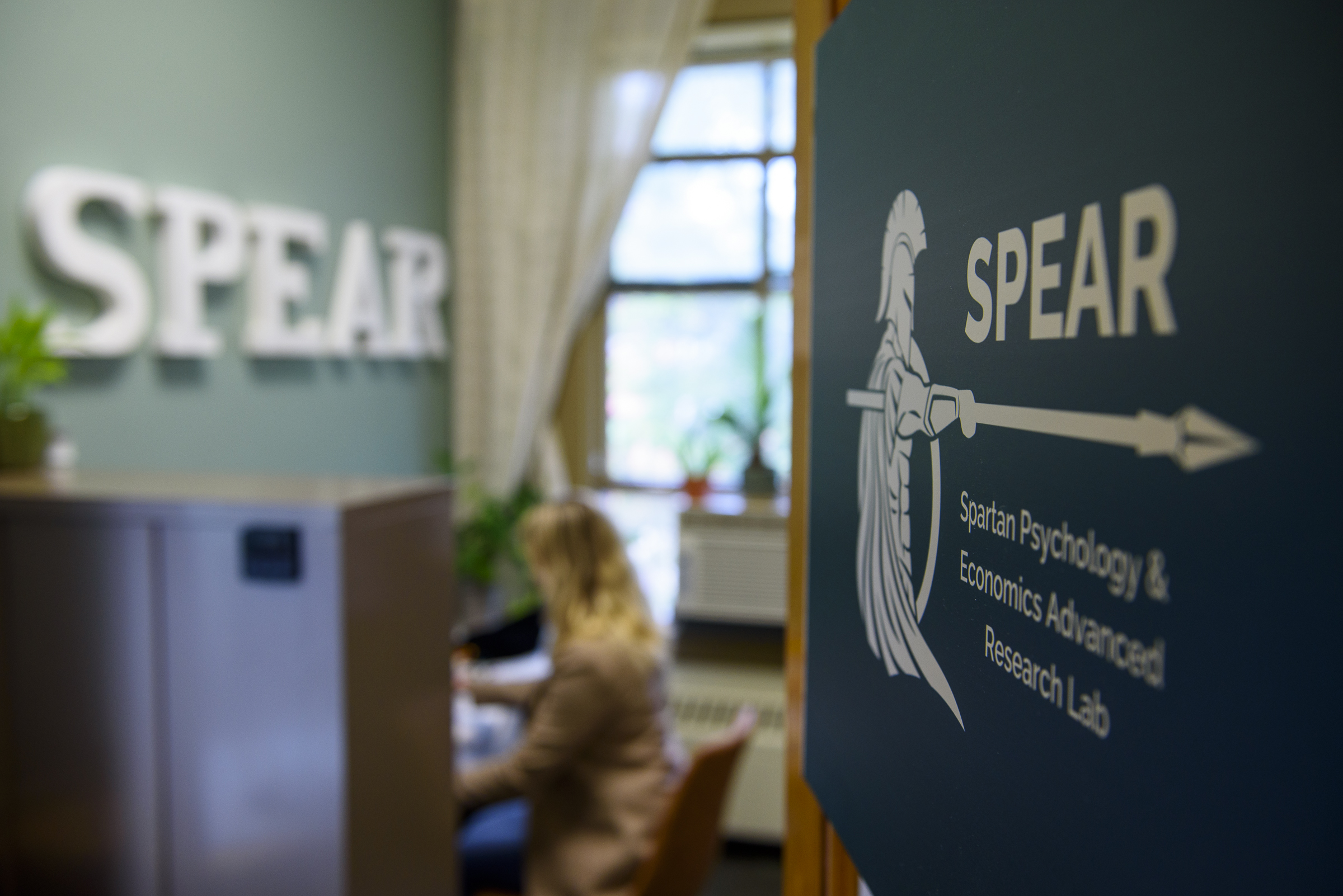
“Part of what I bring as a behavioral and experimental person is a view that we can apply the tools of economics to a lot of different environments. And we can apply the tools in many untraditional ways. We're still writing down math equations and solving things, but in ways that provide insights that are helpful for policymakers as part of our university’s land-grant mission,” he said.
SPEAR Labs is still looking for volunteers for their LEGO bricks building research requiring two sessions, about 45 minutes each. Participants receive $25 for both sessions but up to $35 depending on how many blocks they are able to build. If you're interested in participating in the research study, visit https://bit.ly/SPEARlego.
*The photos in this story were provided by Jackie Hawthorne, College of Social Science photographer.